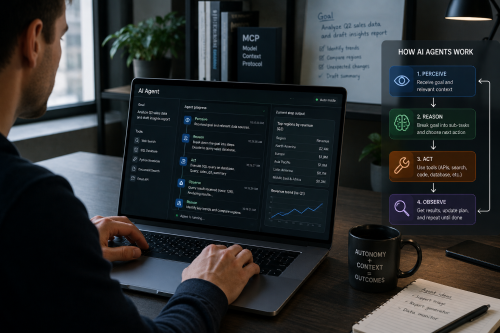
An AI agent is a software system built on a large language model (LLM) that can perceive a goal, reason about the steps needed to reach it, take actions using external tools, and adjust its plan based on the results — largely without step-by-step human instructions. This distinguishes agents from traditional chatbots, which mainly respond to single prompts without independently planning or executing multi-step work.
How AI Agents Work
Most AI agents follow a loop often described as perceive → reason → act → observe:
- Perceive: The agent receives a goal or task and relevant context (documents, prior messages, system state).
- Reason: The underlying LLM breaks the goal into sub-tasks and decides which tool or action to use next.
- Act: The agent calls a tool — a web search, a code interpreter, a database query, or an API — such as those exposed through the Model Context Protocol (MCP).
- Observe: The agent reads the result, updates its plan, and repeats the loop until the goal is met or a limit is reached.
Types of AI Agents
Not all agents are built the same way. Common categories include:
- Single-task agents: Focused on one job, such as drafting emails or summarizing documents.
- Tool-using agents: Can call external APIs, browse the web, or execute code to complete tasks.
- Multi-agent systems: Several specialized agents (a planner, a researcher, a reviewer) coordinate to solve a larger problem.
- Autonomous agents: Operate over longer time horizons with minimal supervision, such as monitoring a system and taking corrective action.
AI Agents vs. Chatbots: What Is the Difference?
A chatbot typically answers one question at a time inside a conversation. An AI agent is given a goal and independently determines the sequence of actions — including calling tools, checking its own output, and retrying — needed to achieve it. The practical difference is autonomy: agents are designed to complete work, not just answer questions.
Real-World Use Cases
- Software development: Coding agents that read a codebase, write and test changes, and open a pull request.
- Customer support: Agents that look up order data, issue refunds, and escalate edge cases to a human.
- Research and analysis: Agents that gather sources, cross-check facts, and produce a structured report.
- Finance operations: Agents that reconcile transactions, flag anomalies, or prepare draft reports for human review (see our guide on AI agents in finance).
Key Risks to Understand
Autonomy introduces new failure modes: agents can misinterpret a goal, call the wrong tool, or take irreversible actions faster than a human can review them. Production deployments generally use guardrails such as scoped permissions, human approval steps for high-impact actions, and detailed action logs.
Getting Started
Most teams start with a narrow, well-defined task (e.g., "summarize new support tickets") before expanding an agent's tool access. Frameworks like LangChain, AutoGPT-style loops, and provider-native agent SDKs (including Anthropic's and OpenAI's) make it possible to prototype an agent in a single afternoon.