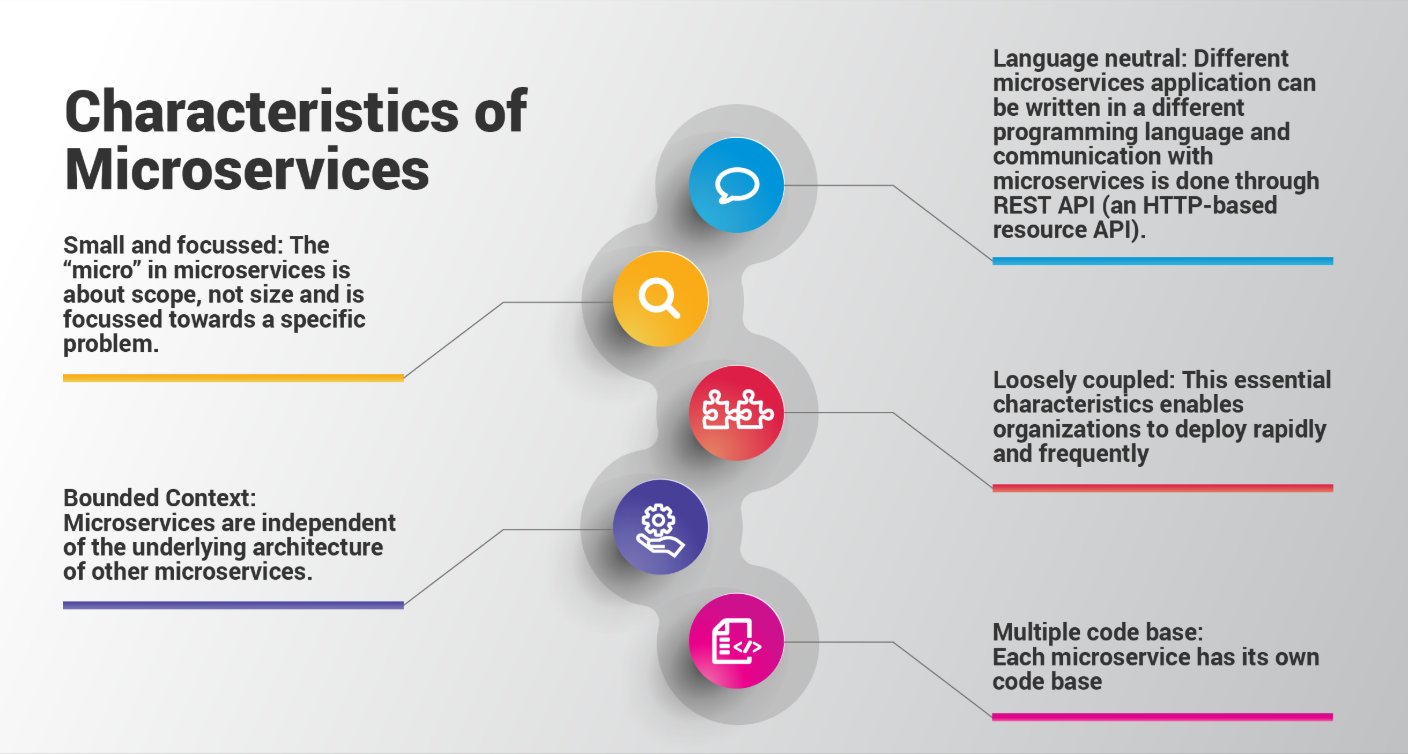
A microservices architecture structures an application as a collection of small, independently deployable services, each owning a specific business capability. Instead of one large codebase handling everything, each service runs on its own, communicates over the network, and can be built, deployed, and scaled independently of the others.
Core Principles
Most microservices designs share a few defining traits:
- Single responsibility: each service owns one business capability (e.g. billing, inventory, notifications).
- Independent deployability: a team can ship a change to one service without redeploying the entire system.
- Decentralized data: each service typically owns its own database rather than sharing one central schema.
- Communication over the network: services talk via HTTP/REST, gRPC, or asynchronous messaging instead of in-process function calls.
Monolith vs. Microservices
A monolith is simpler to develop, test, and deploy early on — one codebase, one deployment, one database transaction boundary. Microservices trade that simplicity for independent scalability and team autonomy, at the cost of operational complexity: network latency, distributed data consistency, and more moving parts to monitor.
When It's Worth the Complexity
- Multiple teams need to ship independently without blocking each other
- Different parts of the system have very different scaling needs
- The codebase has grown large enough that a monolith's build/test/deploy cycle is slowing everyone down
For a small team or an early-stage product, a well-structured monolith is usually the faster, cheaper path — microservices solve organizational and scaling problems that a small team often doesn't have yet.
Common Pitfalls
- Splitting too early: adopting microservices before the domain boundaries are well understood leads to services that constantly need to change together anyway.
- Distributed monolith: services that are technically separate but still tightly coupled and always deployed together — all the network overhead, none of the independence benefit.
- Underestimating observability needs: debugging a request that spans 6 services requires distributed tracing, centralized logging, and good monitoring from day one, not as an afterthought.
Getting Started
Teams migrating from a monolith usually have more success extracting one well-bounded service at a time (the "strangler fig" pattern) rather than a full rewrite — validating the operational tooling (deployment pipeline, monitoring, service discovery) on a low-risk service before splitting out the core of the system.