What is Vibe Coding?
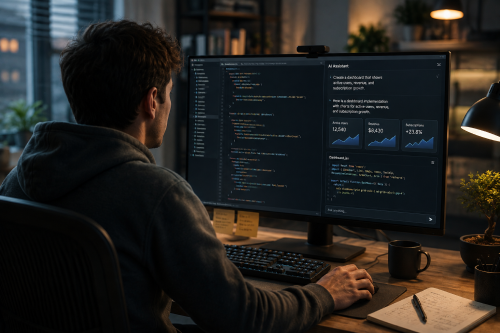
Vibe coding, a term coined by OpenAI co-founder Andrej Karpathy in early 2025, refers to the practice of using AI tools to generate code based on natural language prompts. Instead of writing lines of code manually, developers communicate their intentions through plain English, allowing AI to produce and refine the code. This approach is part of a broader shift toward intent-driven software development, where AI systems assist in building applications with minimal human intervention.
According to IBM, vibe coding represents a significant evolution in software development, moving from strict manual coding to a more flexible, AI-assisted process. Developers focus on the outcome rather than the underlying mechanics, testing and fine-tuning the results as needed.
The Rise of AI-Assisted Development
The adoption of vibe coding has been rapid. By 2025, 85% of developers were using AI coding tools regularly, up from 44% in early 2025. This trend is expected to continue, with Gartner predicting that 90% of global code will be AI-generated by 2027. The impact is already visible: 25% of Y Combinator startups in 2025 built the majority of their codebase with AI assistance, accelerating project completion by up to 55%.
Developers are no longer just code writers; they are becoming AI orchestrators and system architects. The role of the developer is evolving, with a greater emphasis on understanding AI capabilities and leveraging them effectively in the software development lifecycle.
Challenges and Future Outlook
Despite its rapid growth, vibe coding is not without challenges. A recent grey literature review highlights a speed–quality trade-off, where developers prioritize speed over precision. While AI can generate code quickly, the resulting output may require significant refinement and testing. Additionally, there is a growing concern about the reliability and security of AI-generated code, especially in production environments.
Experts like Scott H Young caution that while AI is transforming the nature of work, predicting its long-term impact is difficult. The second- and third-order effects of AI-driven development are still unfolding, and society must adapt to a future where software creation is increasingly automated and accessible to non-technical users.
The Role of AI in the Future of Work
Vibe coding is not just a technical shift—it’s a cultural and societal one. As AI continues to evolve, the barriers to software development are lowering, enabling more people to create applications without deep technical expertise. This democratization of coding has the potential to redefine the workforce, with developers focusing more on design, evaluation, and innovation rather than manual coding.
Harvard researchers, such as Karen Brennan, are already exploring how this shift will shape the future of work. They argue that the ability to articulate a vision and evaluate results will become more important than knowing how to code. The future of software development may be one where AI handles the execution, and humans focus on the creative and strategic aspects.